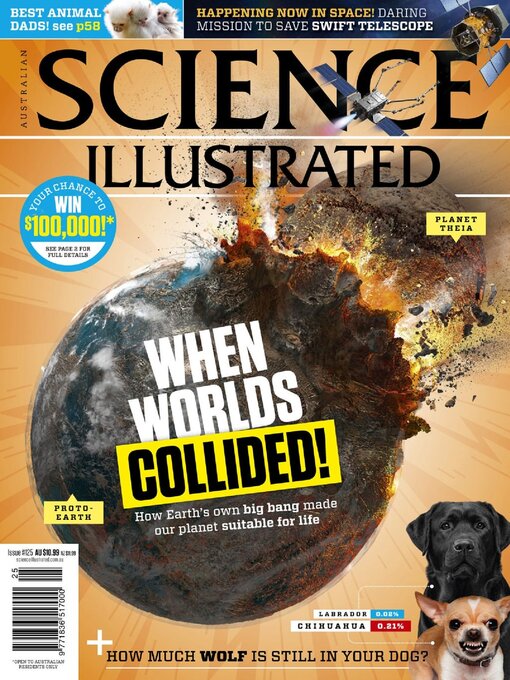
 Issue 125
 Issue 124
 Issue 123
 Issue 122
 Issue 121
 Issue 120
 Issue 119
 Issue 118
 Issue 117
 Issue 116
 Issue 115
 Issue 114
 Issue 113
 Issue 112
 Issue 111
 Issue 110
 Issue 109
 Issue 108
 Issue 107
 Issue 106
 Issue 105
 Issue 104
 Issue 103
 Issue 102
Science Illustrated delivers natural science, break through discoveries and an understanding of the world for the entire family. Packed with stunning photography and in-depth editorial it’s a visually spectacular gateway to the world looking into the beginning of life to distant objects in the universe.
SUBSCRIBE FOR YOUR CHANCE TO WIN $100,000! • What would you do with the ultimate cash prize?
Science Illustrated
MEGAPIXEL
Astronomers discover first lava tube on Venus • While analysing old radar data, researchers found an unusually large underground lava tunnel on Venus. The cavity offers a glimpse into our neighbouring planet’s active volcanic past.
Bonobos have a good imagination
Sitting & standing: using your desk to minimise back pain • Sit-stand desks allow you to change posture, which can help minimise lower back pain. But how long up, and how long down? Research from Queensland finds a golden ratio.
The mysterious case of the mislabelled mammoth bones • Were these the youngest ever woolly mammoths? Or something else entirely?
Plant protein via ultrasound at RMIT • The world needs protein, and current agricultural processes may be discarding useful biomass as waste. RMIT scientists are using ultra-sound to extract plant protein from cauliflower and broccoli leaves.
Friendships keep dolphins young • Dolphins can develop close bonds between individuals, just as humans do. A long-term Australian study has shown that this slows the ageing of their cells.
‘Lucky’ robot maps the ocean under Antarctica’s ice shelves • A robotic float disappeared beneath the ice in East Antarctica. Eight months later, it resurfaced with data that provide new insights into glaciers and future sea levels.
Did we walk on two legs earlier than previously believed? • A seven-million-year-old human-like skull has had researchers divided for decades. New analyses suggest that the species walked on two legs.
Student discovered new planet • Astrophysicist Alexander Venner and an Australian-led team has found a potentially habitable planet orbiting an alien star. Remarkably, Venner found the planet when he still was a teenager.
Iguanodon may have used spines for echidna-like defence • A single, well-preserved fossil of an Iguanodon shows that the giant herbivore was clad with an armour of scales, with dense spines covering areas of its skin.
How does VAR work? (when it does) • “VAR caused multiple controversies during the World Cup. How does the system work, and is it true that there is a microchip inside the ball? Why does it cause so many problems?”
Can skyscrapers influence Earth’s rotation? • “When I stretch out my arms whilst spinning, my speed seems to reduce. Does that mean that skyscrapers have a similar effect on Earth’s rotation?”
TEST YOURSELF • Solve problems designed for different types of intelligence, and find out in which you excel!
What are goosebumps? • Cold, surprise and pleasure can all cause tiny hard goosebumps to appear on the skin. But why do we get goosebumps? What purpose do they serve?
How did smallpox impact First Australians?
Are athletes more likely to suffer cardiac arrest? • There have been several examples of athletes, who might be supposed to have healthy hearts, suddenly collapsing. Are they actually more at risk than the rest of us?
Do humans tolerate hot meals very well? • Animals do not eat hot meals, but humans seem to prefer them. Has evolution made us tolerant to high temperatures?
Many warm-day thunderstorms arrive in the late afternoon. Why?
… Mercury is Earth’s closest neighbour? • “In the order of planets, Venus and Mars are Earth’s neighbours. But I read that Mercury actually comes closest to Earth. Is this true, so our...